
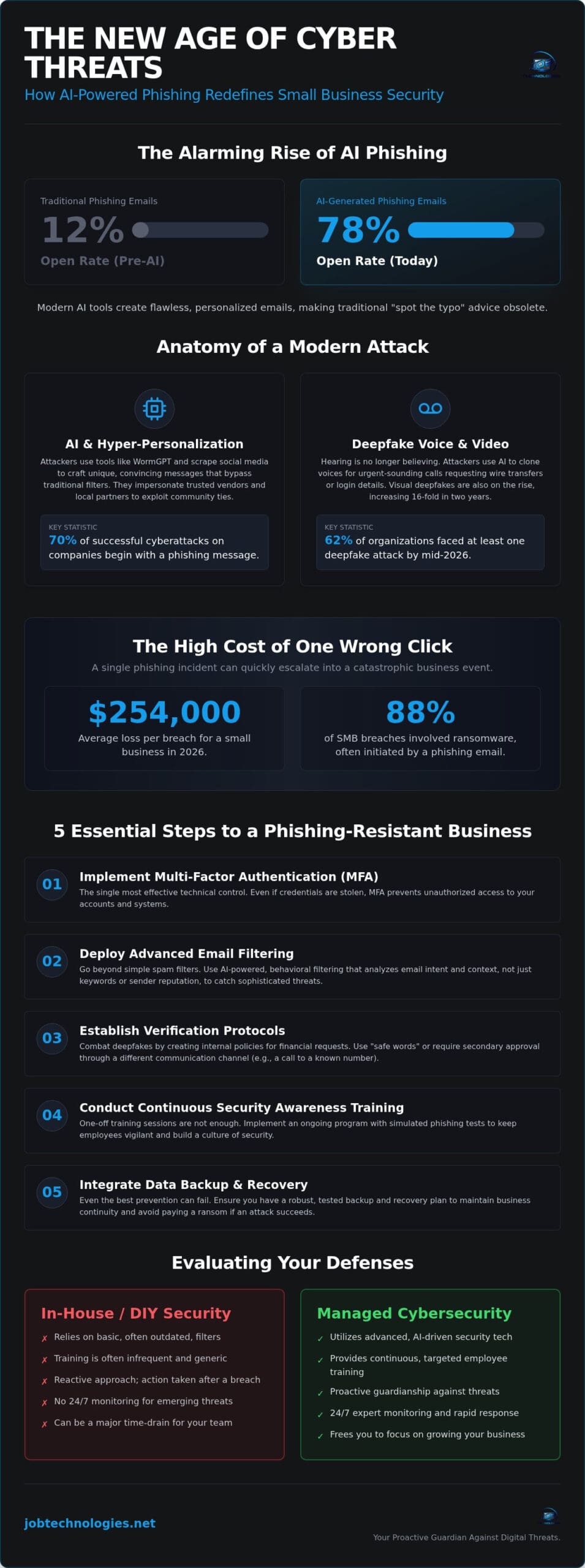
Did you know that AI-generated phishing emails now boast an open rate as high as 78 percent? That’s a staggering jump from the 12 percent we saw just a few years ago. It’s exhausting to feel like your entire livelihood could be dismantled by one accidental click from a distracted team member. You’ve likely spent hours on security training only to see the same basic mistakes happen again, and the technical jargon from most providers doesn’t make things any clearer.
We believe you deserve a security strategy that acts as a proactive guardian, allowing you to focus on growth instead of constant digital threats. This guide will show you how to implement a multi-layered defense that keeps your client data HIPAA and PCI compliant while neutralizing even the most sophisticated AI attacks. By focusing on smart phishing prevention for small business, you can finally gain the peace of mind that your operations are secure. We’ll walk through the latest 2026 regulatory mandates and provide a clear, step-by-step plan to ensure your business stays protected and resilient.
Key Takeaways
- Recognize how modern AI tools allow hackers to create flawless impersonations, which makes traditional advice about looking for typos obsolete.
- Learn why effective phishing prevention for small business requires a multi-layered approach that bridges the gap between smart technology and employee awareness.
- Compare the limitations of DIY security against the peace of mind offered by continuous, managed cybersecurity monitoring.
- Identify the essential technical steps, including MFA and behavioral filtering, that create a proactive shield for your company data.
- Understand how to integrate data backup and recovery into your security plan to ensure total business continuity even if an attack succeeds.
Why Phishing is the #1 Threat to Dubuque Small Businesses in 2026
Phishing is no longer just a poorly written email from a distant stranger. In 2026, it’s a sophisticated, precision-engineered weapon. According to data from April 2026, over 70 percent of successful cyberattacks on companies began with a phishing message. These aren’t just random attempts; they’re often highly personalized. Hackers target firms in Galena and Dubuque specifically because they hope local businesses have fewer defenses than massive corporate entities. They use our local community ties against us, masquerading as trusted vendors or local partners to gain a foothold in your network. For many, the cost of a single click is devastating. With the average loss per breach for small businesses reaching $254,000 in 2026, effective phishing prevention for small business is the difference between continuity and closure.
Phishing vs. Ransomware: The Dangerous Connection
There is a direct, inseparable link between a deceptive email and a total business shutdown. As of September 2026, 88 percent of small business breaches involved ransomware. When an employee accidentally shares credentials, they aren’t just opening one door; they’re handing over the keys to your entire digital vault. This is why we focus so heavily on ransomware protection for SMBs. Prevention is 10 times cheaper than recovery. We’ve seen local offices paralyzed for weeks because of one “urgent invoice” link. While you’re locked out of your files, your reputation takes a hit that’s hard to repair. A proactive approach stops the infection before it ever reaches your servers.
The Evolving Risk for Local Industries
Attackers have shifted from a “spray and pray” method to highly targeted spear phishing. They study local supply chains to exploit the relationships between Tri-State area businesses. This is particularly dangerous for specific sectors:
- Healthcare Providers: A phishing breach can lead to massive HIPAA fines and the loss of sensitive patient trust.
- Law Firms: Compromised emails can lead to “Business Email Compromise” (BEC), where hackers intercept wire transfers or sensitive case data.
- Manufacturing: Intellectual property and proprietary processes are high-value targets for digital thieves.
Implementing robust phishing prevention for small business helps you avoid these pitfalls. By understanding that your business is a target regardless of its size, you can take the necessary steps to protect your data. We see ourselves as your proactive guardian, helping you identify these risks before they turn into operational disasters. It’s about building a culture where security is second nature, ensuring your team catches the subtle red flags that AI tools now produce with ease.
Anatomy of a Modern Attack: AI-Generated Phishing and Deepfakes
The days of identifying a scam by its poor grammar or generic “Dear Customer” greeting are over. Today, attackers use sophisticated AI tools like WormGPT to craft messages that are indistinguishable from legitimate business correspondence. These tools allow hackers to generate unique, non-templated content in seconds, which is why traditional email filters are struggling to keep up. When every message is a one-of-a-kind creation, blacklists and pattern matching simply don’t work. This evolution is why modern phishing prevention for small business must look beyond the inbox and address the human element of social engineering. Hackers now manipulate your team’s emotions and sense of urgency with terrifying precision. Investing in robust email security solutions for business is now a foundational requirement for any organization that wants to stay ahead of these AI-driven threats.
Deepfake Voice Scams: The New Office Threat
In 2026, seeing and hearing is no longer believing. Deepfake technology has become a mainstream attack vector, with an estimated 8 million deepfakes circulating online according to StationX. This represents a 16-fold increase in just two years. Your team might receive a phone call that sounds exactly like you, authorizing an urgent wire transfer or requesting sensitive login details. According to Netarx, 62 percent of organizations faced at least one deepfake attack by July 2026. To counter this, we recommend establishing internal verification protocols, such as “safe words” or secondary approval steps for any financial request. It’s about adding a layer of human logic to your cybersecurity and ransomware protection strategy.
Hyper-Personalized Spear Phishing
Hackers now scrape LinkedIn profiles and local news to build trust with your employees before they even send an email. They know who your vendors are, which charity events you attend, and even when you’re out of the office. These spear phishing attempts often hide behind mundane topics like a missing package notification or an updated HR policy. Because these emails contain specific, accurate details about your business, they easily bypass the mental guards of even the most diligent employees. AI-phishing acts as a specialized tool that removes the obvious red flags of the past, making the threat nearly invisible to the naked eye. This level of personalization is why effective phishing prevention for small business requires a proactive guardian to monitor for these subtle, high-risk anomalies.
Evaluating Your Defenses: In-House Training vs. Managed Security
Relying on a “DIY” approach for cybersecurity is becoming a dangerous gamble. As a business owner, your focus should be on growth and operations, not tracking weekly threat updates or deciphering complex technical logs. Effective phishing prevention for small business requires more than just a passing interest; it demands constant vigilance that most in-house teams simply can’t sustain. When you manage your own security stack, the hidden expenses of downtime, missed updates, and individual software licenses often outweigh the cost of a professional partnership. It’s about shifting the burden from your shoulders to a steady hand that understands the technical complexity and can navigate it for you.
Why Employee Training Often Fails
Traditional once-a-year seminars suffer from what’s known as the “forgetting curve.” Without consistent reinforcement, employees often lose most of what they’ve learned within just a few weeks. Beyond memory loss, there’s the issue of “security fatigue.” When your team is overwhelmed by notifications and urgent tasks, they often click links out of habit rather than caution. We’ve found that simulated phishing tests are a much more effective tool. They identify high-risk internal gaps in a safe environment, allowing us to provide targeted education where it’s needed most without causing unnecessary stress or operational friction.
The Managed IT Advantage for Cybersecurity
Moving from a reactive to a proactive stance is the core benefit of managed IT services. Instead of waiting for a breach to occur, we deploy AI-driven threat detection that learns your specific business patterns to spot anomalies instantly. This technology acts as a “set it and forget it” security layer, providing the peace of mind you need to run your business. At JOB Technologies, we act as a proactive guardian and a literal extension of your team in the Dubuque and Galena area. We provide 24/7 monitoring and prioritize a 15-minute response time. This ensures that a single suspicious email doesn’t escalate into a total network lockout. Our local on-site support means we aren’t just a distant vendor; we’re a partner invested in the health of our local business ecosystem. We take the technical complexity off your plate so you can focus on what you do best.
5 Essential Steps to Build a Phishing-Resistant Business
Building a resilient defense isn’t about a single piece of software. It’s about creating a multi-layered strategy that addresses both technical vulnerabilities and human behavior. By following these five steps, you can significantly reduce your risk and ensure your team is prepared for modern AI-driven attacks. This proactive approach turns your organization from a target into a fortress. We believe in providing a steady hand to guide you through these implementations, ensuring that your phishing prevention for small business is both effective and easy to manage.
The Power of Multi-Factor Authentication
Multi-Factor Authentication (MFA) is the single most effective deterrent against credential theft. We recommend moving beyond SMS codes, which can be intercepted by sophisticated hackers, and using secure authenticator apps or physical hardware keys instead. MFA turns a stolen password into a useless string of characters. By requiring a second form of verification that only the authorized user possesses, you neutralize the primary goal of most phishing attempts. It’s a simple step that provides an immense amount of peace of mind.
Deploying advanced email security solutions for business is your next line of defense. Unlike traditional filters that rely on outdated blacklists, modern solutions use behavioral analysis to spot non-templated AI messages that appear legitimate. This technology looks for subtle anomalies in communication patterns rather than just known malicious links. Alongside this tech, you must establish a “Culture of Verification.” Every financial or data request, especially those marked as urgent, should be confirmed through a secondary, pre-approved channel. This simple habit prevents social engineering from gaining a foothold in your daily operations.
Endpoint Protection and Remote Work Security
As remote work continues to grow for teams in Galena and Dyersville, securing the “work from home” gap is critical. Office PCs are often protected by corporate-grade hardware, but mobile devices and home networks can be dangerous weak points. We implement managed firewalls and encrypted VPN connections to ensure that your internet-connected technology is secure regardless of location. This ensures that a distracted click on a personal phone doesn’t provide a gateway into your professional network. We take pride in securing your assets wherever your team happens to be working.
Finally, partner with a Managed IT Service provider in Dubuque. Expert oversight ensures that these security layers stay updated against the latest 2026 threats. We don’t just set up a firewall and walk away. We provide continuous monitoring and adjustment, acting as a proactive guardian for your digital assets. This collaborative partnership allows you to focus on your business goals while we handle the technical complexity of modern phishing prevention for small business. If you’re ready to build a more secure future, learn more about our cybersecurity and ransomware protection.
Beyond Prevention: Ensuring Business Continuity and Recovery
Even the most robust phishing prevention for small business cannot guarantee 100 percent protection in a world of deepfakes and AI-assisted social engineering. The reality of the 2026 threat landscape is that no defense is entirely foolproof. You need a “Plan B” that ensures your business stays operational even if a team member accidentally bypasses your primary security layers. This is where the connection between phishing and ransomware becomes critical. If a stolen credential leads to a network lockout, your ability to recover depends entirely on your data backup and recovery strategy. Managed backups allow you to “rewind” your entire system to a point in time before the infection occurred, effectively neutralizing the attacker’s leverage.
Compliance standards like HIPAA or the SEC’s amended Regulation S-P require more than just prevention. They mandate a written incident response program and specific notification windows for individuals affected by a breach. Having a steady hand to guide you through these regulatory hurdles ensures that a security incident doesn’t turn into a legal or financial catastrophe. We focus on safeguarding your reputation as much as your data, ensuring you meet every mandate while maintaining the trust of your clients.
Data Backup: Your Ultimate Safety Net
It’s a common mistake to confuse simple cloud storage with a managed backup solution. While cloud storage syncs your files, it can also sync the ransomware that encrypts them. A true safety net follows the 3-2-1 backup rule: three copies of your data, stored on two different formats, with at least one copy kept off-site. At JOB Technologies, we ensure your data is recoverable in minutes, not days. We focus on business continuity, meaning we don’t just save your files; we ensure your entire operational environment is ready to be restored so you can get back to work without delay.
Next Steps for Local Business Owners
For local business owners in Dubuque or Galena, the path forward starts with a clear understanding of your current vulnerabilities. A network security audit for small business is the first step in moving from a reactive “hope for the best” mindset to a proactive, guarded stance. A collaborative partnership provides far more value than a hardware-only vendor because we act as an extension of your team. We prioritize your specific daily operations and long-term goals over technical prowess. Comprehensive phishing prevention for small business is about more than software; it’s about having a partner who is deeply invested in the health of our local business ecosystem. Schedule your cybersecurity assessment with JOB Technologies today to gain the peace of mind that comes with a multi-layered, professional defense.
Secure Your Digital Future Today
The threat landscape of 2026 demands a proactive guardian rather than a reactive fix. We’ve explored how AI-driven attacks and deepfakes have changed the rules, making traditional filters less effective on their own. By implementing a multi-layered strategy that includes MFA, behavioral filtering, and a robust verification culture, you build a resilient foundation. However, the most critical element is ensuring your business can recover instantly if a breach occurs.
Effective phishing prevention for small business isn’t a “set it and forget it” task; it’s a continuous commitment to your data’s integrity. With over 20 years of local experience, we act as a steady hand to guide you through these technical complexities. We provide comprehensive ransomware protection and back it up with a 15-minute response time guarantee. You don’t have to navigate these risks alone.
Secure your business with JOB Technologies Managed IT today. Let’s work together to protect your reputation and ensure your operations remain uninterrupted. You’ve built something great; we’re here to help you keep it safe.
Frequently Asked Questions
What is the most common type of phishing in 2026?
AI-generated spear phishing is the most prevalent threat we see in 2026. These attacks use tools to scrape personal data from LinkedIn and local news to create highly convincing messages. Research shows that over 70 percent of successful cyberattacks now begin with these deceptive messages. Unlike the generic scams of the past, modern phishing prevention for small business must account for these hyper-personalized attempts that often bypass traditional grammar-based filters.
Can an iPhone or Android phone get a phishing virus?
Yes, mobile devices are frequent targets for smishing (SMS) and vishing (voice) attacks. While people often associate viruses with PCs, phishing on a phone is usually about stealing credentials or intercepting MFA codes. For businesses in Dubuque or Galena with remote employees, these devices often lack the managed firewalls found in a traditional office. Securing every endpoint is a critical part of a modern cybersecurity and ransomware protection strategy.
How can I tell if an email is sent from an AI or a real person?
It is becoming nearly impossible to distinguish AI-generated emails from human ones because tools like WormGPT produce perfect, non-templated prose. You should focus on the context of the request rather than the writing style. If an urgent financial request arrives, verify it through a phone call or a pre-approved internal channel. We help our local partners establish these verification protocols to ensure that a flawless email doesn’t lead to a successful breach.
Does my business insurance cover losses from phishing scams?
Standard general liability policies rarely cover digital theft. You typically need specific cyber liability insurance. In 2026, many insurers have made reasonable security measures a prerequisite for coverage. This includes implementing MFA, having a written information security plan, and maintaining robust data backup and recovery systems. We work with local firms to ensure their technical environment meets these insurance and regulatory standards to avoid denied claims after an incident.
What should I do immediately if an employee clicks a suspicious link?
You must act within minutes to contain the potential threat. First, disconnect the affected device from the network to stop any lateral movement. Next, force a password reset for all compromised accounts and alert your managed IT partner immediately. At JOB Technologies, we provide a 15-minute response time guarantee to help Dubuque businesses neutralize these threats before they escalate into a full network lockout or a costly ransomware event.
Is multi-factor authentication (MFA) really necessary for a small business?
Absolutely. MFA is no longer optional; it’s a foundational requirement for phishing prevention for small business. In 2026, regulatory bodies like the FTC and SEC have made these measures enforceable mandates for many sectors. MFA turns a stolen password into a useless string of characters by requiring a second, physical form of verification. It is the most effective way to protect your reputation and client data from unauthorized access.
How much does managed phishing protection cost for a small office?
The cost of managed protection is tailored to your specific needs, such as the number of users and your industry’s compliance requirements. While we don’t provide flat pricing without an assessment, it is important to weigh the investment against the potential cost of a breach. With the average small business loss per breach reaching $254,000 in 2026, proactive monitoring is a fraction of the cost of recovery and lost operational time.
What is the difference between phishing and spoofing?
Phishing is the overall scam intended to steal data or install malware. Spoofing is a specific technique used within that scam to make an email or phone call appear to come from a trusted source. For example, a hacker might spoof a local Galena vendor’s email address to send a phishing link. Understanding this difference helps your team recognize that even if a sender’s name looks correct, the underlying intent might be malicious.