

Growth shouldn’t depend on the next technology fire drill. A technology roadmap for business growth sets out the systems a company uses today, the improvements it plans, and the technology it will phase out. It connects those decisions to business goals and identifies the capabilities to build over the next 24 to 36 months.
Technology decisions can easily become reactive: urgent issues demand attention, while longer-term improvements compete for time and resources. A clear technology roadmap for business growth brings those priorities into view. It helps you plan milestones, weigh investments against business needs, and avoid adopting technology simply because it is new.
This guide explains how to build a roadmap around business goals, sequence projects into practical milestones, and account for the people and resources needed to deliver change. You’ll also learn how to review progress and adjust priorities as conditions shift, keeping technology plans connected to growth rather than locked to an outdated schedule.
Key Takeaways
- Map the technology you rely on today against the capabilities your business will need to meet its goals.
- Rank initiatives by cost, potential return, and strategic fit instead of chasing every new technology trend.
- Break approved changes into milestones, with clear timelines, resource needs, expected outcomes, and plans for training.
- Use stakeholder feedback and performance measures to spot when priorities need to change.
- Connect technology decisions to business growth so teams can coordinate investments and reduce last-minute choices.
What Is a Technology Roadmap?
A technology roadmap is a strategic plan for the systems a business uses, improves, and eventually phases out. It connects today’s technology decisions to business goals and the capabilities needed over the next 24 to 36 months.
-
Treat the Roadmap as a Strategic Plan
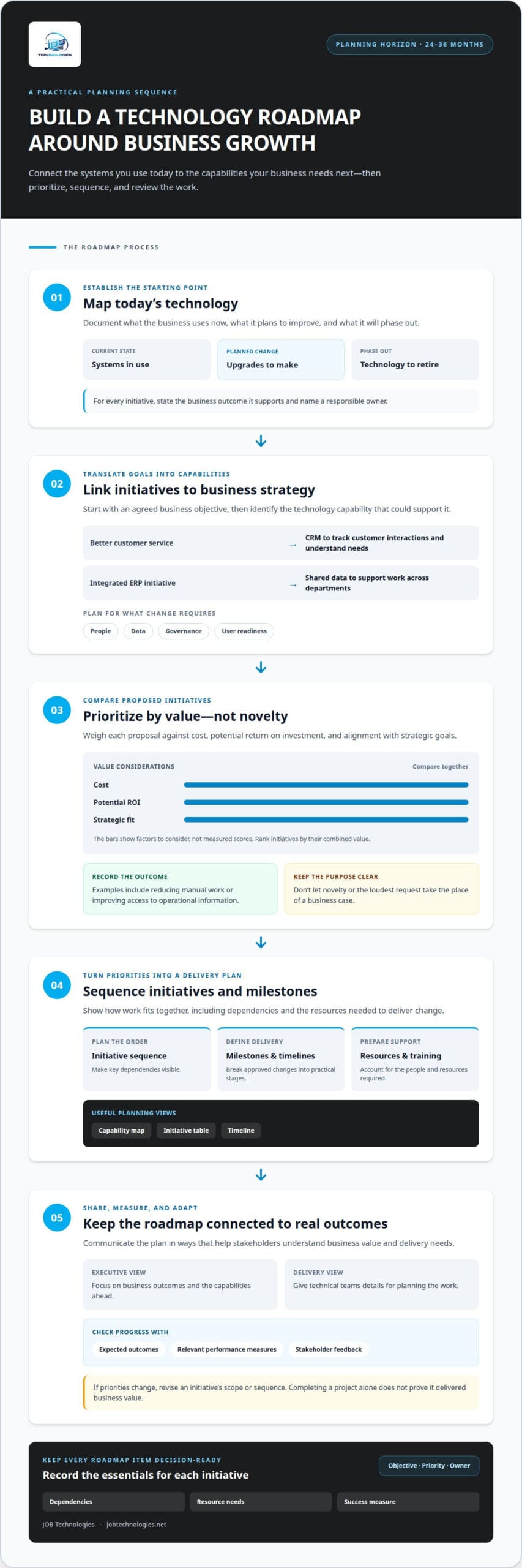
Start by documenting your current systems, planned upgrades, and technology to phase out. For each change, describe the business vision it supports instead of treating the roadmap as a disconnected IT wish list. A startup may focus on essential capabilities, a small business on process improvements, and an enterprise on dependencies across teams and systems.
For every initiative, name its business outcome and a responsible owner. Don’t list tools without explaining how they help the organization reach its goals.
-
Link Initiatives to Enterprise Strategy
Translate each company objective into a technology capability. If the strategy calls for better customer service, for example, a CRM system can help teams track customer interactions and understand needs. For an integrated ERP initiative, map how shared data could support work across departments.
Include the people, data, governance, and user readiness required for major changes. A strategic partner can help assess CRM or ERP transformation needs, dependencies, and implementation priorities while keeping the business objective central.
-
Prioritize Initiatives by Cost and ROI
Compare proposed initiatives by cost, potential return on investment, and alignment with strategic goals. Record the expected business outcome beside each investment, such as reducing manual work or improving access to operational information. Rank initiatives by their combined value, not by novelty or the loudest request.
The cost to develop and implement a roadmap depends on its scope, existing systems, integrations, and internal resources; pricing is determined after a quote request. Use those factors to define what the work includes before comparing options.
-
Communicate Strategy to Stakeholders
Build a roadmap that shows the current state, future capabilities, initiative sequence, and key dependencies. Share an executive-level view focused on business outcomes, then give technical teams the details they need to plan delivery. Ask employees and department leads for input, not just executives.
Use a simple capability map, initiative table, and timeline as practical planning tools. Measure success against each initiative’s expected outcome using relevant performance measures and stakeholder feedback. Completing a project alone does not prove it delivered business value.
For each roadmap item, document its objective, priority, owner, dependencies, resource needs, and success measure. This structure helps teams compare proposals consistently and gives decision-makers a clear basis for sequencing work.
What Happens When Technology Decisions Stay Reactive?
Align technology strategy with business goals by translating each priority into a capability, investment, and expected outcome. For example, a customer-service goal may require better access to customer information, not simply a new tool.
-
Align Investments with Business Priorities
Start with the business priorities leaders have agreed on, then map each proposed technology investment to one of them. If a company aims to improve customer service, assess whether a CRM could help teams track interactions and understand customer needs. Don’t choose a tool first and search for a business case afterward.
Next, compare initiatives by their expected contribution to those priorities. A project that reduces manual work may support operational efficiency, while an upgrade with unused features may not advance a current objective. Record the reason for each investment and the outcome that would show it is helping.
Reactive decisions often start with a visible problem, such as a system outage or a department’s request. Address the immediate issue, but also ask whether it affects a strategic priority. This distinction separates essential work from convenient upgrades, so urgent requests don’t automatically displace planned investments.
-
Connect Business and IT Alignment
Bring business leaders, IT staff, and affected employees into the same planning conversation. Ask each group to describe the problem in operational terms, then identify the technology capability that could address it. A sales team, for example, may need reliable customer records, while IT assesses integration and data needs.
Check that the proposed change fits the company’s direction and can be supported by its people, data, governance, and security. A new system can create friction if teams lack training or departments maintain separate processes. Account for these dependencies before approving the investment, not during implementation.
Use a shared decision record to connect each project with its business owner, intended outcome, and dependencies. Review stakeholder feedback and relevant performance measures as work progresses. If a project no longer supports a priority, revise its scope or sequence instead of continuing simply because work has begun.
For help connecting technology planning with operational needs, explore technology planning support as a next step.
Choose technology that aligns with business objectives and growth plans, rather than adopting trends simply because they are new. This gives decision-makers a consistent way to weigh options: does the technology support the direction the business has chosen, or is it merely attracting attention? Keeping that distinction clear prevents novelty from replacing a defined business purpose.
Planning project milestones and deadlines
Create a roadmap by defining business goals, identifying needed capabilities, sequencing initiatives, and assigning owners, resources, milestones, and expected outcomes. For small and midsize businesses in 2026, AI implementation and data analytics may support growth when they address a clear business need, rather than simply follow a technology trend.
-
Plan Technology Implementation
Break each approved initiative into milestones that show meaningful progress, such as assessing current systems, preparing data, configuring a solution, testing it, and moving into use. Set a deadline and owner for every milestone, then identify tasks that depend on earlier work. A CRM rollout, for example, may require clean customer records before teams can use it effectively.
Record the people, time, and funding each stage requires, along with its expected outcomes. Allow time for testing and resolving issues. A schedule that covers only installation can overlook the work needed to make a change usable.
-
Plan for Technology Adoption
Plan training, change management, and support as part of implementation, not as follow-up tasks. Identify which roles will use the new system and how their daily work will change. For an AI implementation, define the business process it will support and prepare users to apply it within that process.
Account for possible productivity declines while employees learn a new system. Gather questions from affected teams before launch, then use them to shape training and support. Avoid setting a rollout deadline that assumes every user will adopt the technology immediately.
- Look ahead to future capabilities. Consider how customer expectations, the business environment, and technology trends could change the systems your company needs. Map required capabilities over the next 24 to 36 months, then organize potential projects around those needs. Treat that horizon as a planning guide, not a reason to commit to every forecast.
A business seeking better decisions from its data might evaluate analytics tools. Another company may prioritize AI implementation for a defined workflow. The right choice depends on strategic goals, available resources, and whether the technology addresses a real operational need.
- Build a schedule you can manage. Collect input from leadership, IT, and employees who will use the systems. Put milestones, deadlines, dependencies, required resources, and expected outcomes into one plan. Check the sequence for workload conflicts, such as scheduling staff training during another major operational change.
Assign a roadmap owner to track progress and flag changes that affect delivery. When a dependency slips, assess which milestones and business outcomes are affected, then revise the sequence. This keeps deadlines useful for decision-making instead of turning them into fixed dates detached from delivery conditions.
Adapting the roadmap when business conditions change
A roadmap should respond to meaningful changes, not every new request. Use stakeholder feedback and performance measures to decide when priorities, timelines, or planned capabilities need revision.
- Identify the change and its business impact. Record what has shifted, such as customer expectations, a new operational challenge, or a change in growth plans. Identify the affected business objective and technology initiatives. If customers increasingly expect faster service, for example, examine whether current systems support the response process.
Distinguish a short-term disruption from a lasting change in direction. Ask affected teams what has changed in their work, then compare their feedback with relevant performance measures. A clear impact statement helps prevent a temporary issue from unnecessarily reshaping the entire roadmap.
- Review active initiatives against current outcomes. For each project, compare its expected business outcome with results and feedback so far. If a system change was intended to improve access to information, assess whether teams can use that information effectively. Note dependencies, delays, and new challenges that could affect delivery.
Keep the review focused on evidence tied to the original objective. Stakeholder feedback may reveal workflow problems a project dashboard misses, while performance measures can show whether the intended change is taking hold. Consider both before deciding whether an initiative remains relevant.
- Adjust priorities, scope, or sequence. Move an initiative forward when it addresses a more pressing business need, or defer work whose value has declined. If a new challenge emerges, define the capability needed before adding a technology project. Consider whether existing systems can meet the need with a smaller adjustment.
Check how each proposed change affects other projects. Delaying a data migration, for example, may also affect reporting improvements that depend on it. Update those dependencies and expected outcomes together, rather than changing one milestone and leaving related commitments untouched.
- Document and communicate the revised plan. Update the roadmap with changed priorities, owners, milestones, dependencies, and expected outcomes. Explain why the plan changed and which business objective now guides the decision. Clear reasoning helps teams see that a revised sequence reflects current conditions, not arbitrary direction.
Share relevant updates with leadership, IT teams, and employees affected by the change. Invite feedback on practical impacts, such as training needs or competing workloads. Keep a record of decisions and their rationale so future reviews can build on earlier choices instead of restarting the discussion.
Roadmap benefits for business growth
A roadmap turns technology from a collection of purchases into a way to build business capabilities. Use it to connect operational improvements, customer needs, and investment decisions to specific growth objectives.
- Choose a growth objective and define technology’s contribution. Start with a business outcome, such as improving customer service or operational efficiency, then identify the capability that could support it. A CRM may help teams track customer interactions, while analytics tools can reveal patterns in business data. The roadmap makes this connection visible before teams commit resources.
Set a measurable objective so progress has a reference point. For example, a roadmap might use improving operational efficiency by 15% as an illustrative target. Treat that figure as a planning example, then define the measure that best reflects your own process and business conditions.
- Use sequencing to make growth investments manageable. Put foundational work before projects that depend on it. If a reporting initiative needs consistent data from several systems, plan the data work first. This makes dependencies clear and helps teams avoid investing in a later capability before the necessary groundwork is ready.
Compare projects by business value, required resources, and alignment with company priorities. A roadmap clarifies why one initiative comes first and what must be in place before another begins. That shared direction helps leaders make trade-offs without treating every request as equally urgent.
- Connect technology choices to customer and team outcomes. Map each initiative to the people who will benefit and the work it will change. For a customer-service goal, a CRM might help staff understand customer needs through interaction records. For an efficiency goal, automation or analytics may be relevant when they address a defined process.
Then identify the outcome that would show progress, such as fewer manual handoffs or better access to information. These are measures to consider, not guaranteed results. Clear measures help teams assess whether an investment supports growth or needs a different approach.
- Make progress visible and decisions easier to explain. Share a business-focused roadmap with leaders and a delivery-focused view with project teams. Show each initiative’s objective, dependencies, owner, and intended outcome. This helps departments understand how their work contributes to wider company priorities.
Assign an owner to maintain the plan and bring forward evidence from project results and stakeholder feedback. When an initiative no longer supports growth, decision-makers can adjust its scope or position. A roadmap is useful because it guides choices, not because every item stays fixed.
If your technology priorities need a clearer connection to business growth, get help planning technology investments.
JOB Technologies: Managed IT Services
JOB Technologies provides Managed IT Services to help businesses manage the technology behind their growth plans. When roadmap priorities involve network improvements, Network Installation & Management can support the infrastructure work. For a defined process that could benefit from artificial intelligence, AI Implementation offers a path to put that capability into practice. Phone Systems VoIP can address business communication needs.
Turn to JOB Technologies when planned technology initiatives need practical support, or when day-to-day IT demands make it difficult to move projects forward. Discuss which business goals your roadmap needs to support and how these services fit those priorities.
Contact JOB Technologies to discuss your technology roadmap.
Make your next technology decision count
A technology roadmap for business growth should guide the next decision, not sit untouched after planning. Before advancing another initiative, choose the project most clearly connected to a current business priority. Define what must be ready, who needs to be involved, and what evidence will help you decide whether to proceed.
That decision can also reveal where expert support would make planning and delivery more manageable. JOB Technologies offers Managed IT Services, Network Installation & Management, and AI Implementation to help businesses align their technology environment with operational needs and growth plans.
Bring your priorities and upcoming initiatives into a focused conversation, then identify a practical path forward. Contact JOB Technologies to plan your roadmap. A considered next step can help your team move forward with greater clarity and confidence.
Frequently Asked Questions
Can a Roadmap Accelerate Modernization Without Increasing Risk?
Yes, a roadmap can support modernization while managing risk through readiness checks before major changes. Assess whether security, data, governance, and user readiness support the planned work. Before migrating customer records, for example, confirm that teams can protect, organize, and use the data. Staged approvals also give leaders a chance to address identified gaps before dependent projects proceed.
Why Does a Roadmap Improve Investment Decisions?
A roadmap makes assumptions and dependencies visible, helping leaders compare proposals using consistent criteria. Ask which business outcome each investment supports, what resources it needs, and what evidence would indicate value. A reporting upgrade, for example, may depend on reliable data inputs. Recording that dependency helps decision-makers sequence investments and avoid downstream commitments before essential groundwork is ready.
What is a technology roadmap for business growth?
A technology roadmap for business growth connects a company’s current systems with planned initiatives and future capabilities. It can identify upgrades and systems to phase out, then show how those changes support business objectives. A small business might focus on core operations, while an enterprise maps dependencies across departments. Let business needs determine the roadmap’s scope, rather than turning it into a catalog of tools.
How do you prioritize technology investments by ROI and business impact?
Compare each investment by its expected business impact, cost, potential return, and readiness. First, define the outcome in operational terms. Then identify required resources and dependencies before ranking the initiative against strategic priorities. A tool intended to speed reporting, for example, may have limited value if its data inputs remain fragmented. Reassess the ranking as evidence changes instead of treating an early estimate as a result.
How often should a business review and update its technology roadmap?
Review the roadmap at planned management checkpoints and whenever business conditions or new challenges shift priorities. Use stakeholder feedback and relevant performance measures to assess whether initiatives still support growth. A business serving customers in Dubuque, Galena, East Dubuque, Dyersville, Farley, or Peosta might reassess plans as customer expectations or operating demands change. Assign an owner to record decisions and explain updates.
What are the risks of a technology roadmap, and how can businesses mitigate them?
Common risks include outdated priorities, unrealistic project dependencies, and changes that outpace staff readiness. Mitigate them by assigning a roadmap owner, involving affected employees, and checking security, data, governance, and user readiness before major changes. Track whether each initiative is delivering its intended outcome. If feedback or performance measures reveal a mismatch, adjust the scope or sequence instead of continuing with an obsolete plan.