

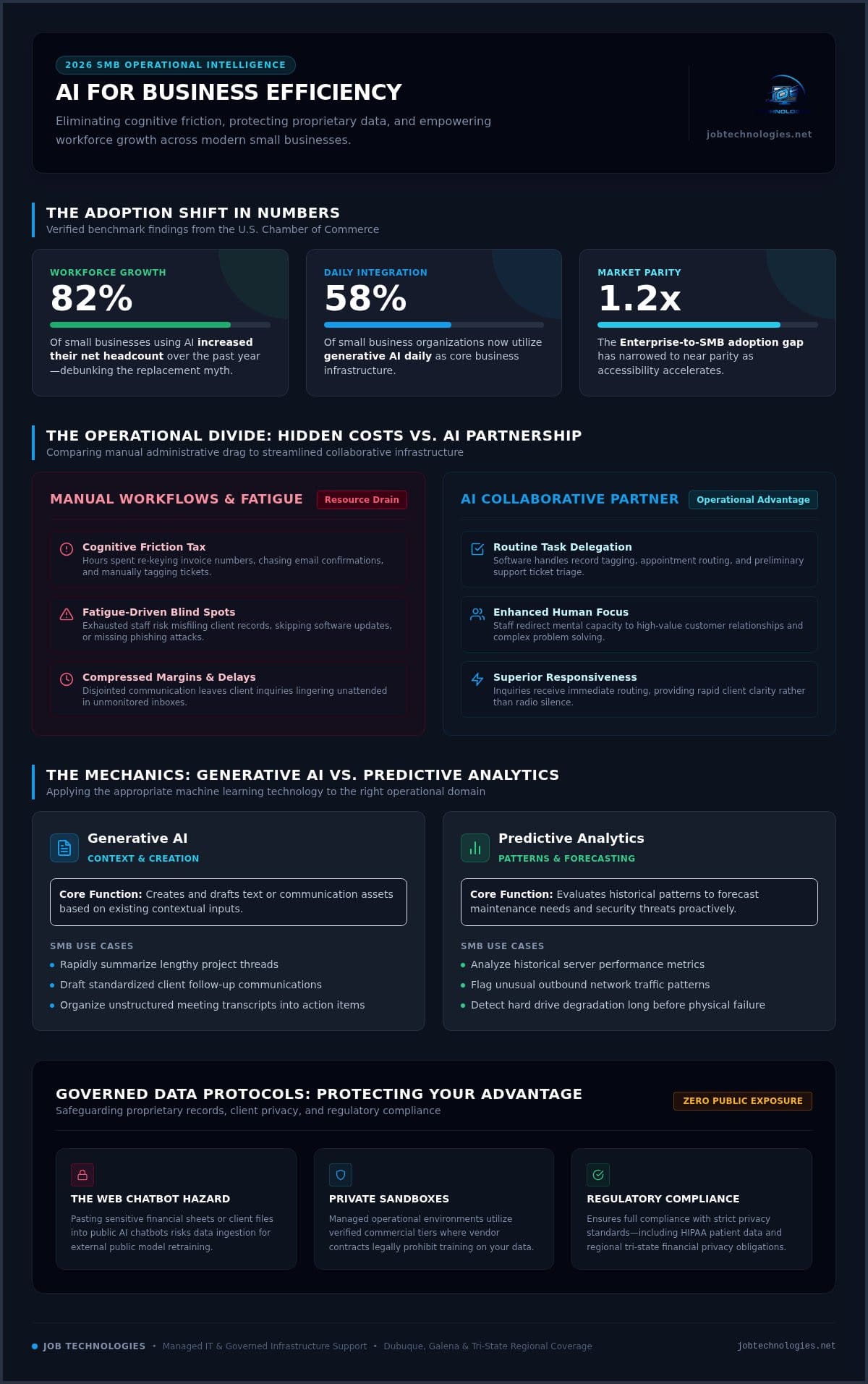
According to the U.S. Chamber of Commerce, 82% of small businesses using artificial intelligence actually increased their net headcount over the past year. Deploying AI for business efficiency isn’t about replacing your dedicated staff; it’s about giving your team a steady, proactive partner to shoulder repetitive daily friction. If you find yourself wrestling with rising operational costs, bogged down by manual workflows, and concerned about customer data security, you aren’t alone. You shouldn’t need to hire an expensive data scientist just to make your workday run smoothly.
You’ll discover how secure, properly governed AI implementation transforms daily operations from an administrative burden into a lasting competitive advantage. We’ll explore five real-world 2026 small business examples showing how teams reclaim valuable hours for high-touch customer work, trim operational overhead, and speed up response times with complete peace of mind.
Key Takeaways
- Understand how AI for business efficiency eliminates cognitive friction and keeps repetitive administrative chores from eating into your margins.
- Discover why governed data protocols protect your proprietary records and client privacy before your team connects everyday workflows to modern models.
- See how moving beyond reactive, break-fix support to proactive, AI-assisted infrastructure safeguards your network continuity.
- Explore practical SMB use cases in document processing and support triage that trim overhead while accelerating customer response times.
- Learn why working with a local IT partner prevents the critical security and compliance blind spots common in do-it-yourself implementations.
The Efficiency Gap: Why Small Businesses Need AI in 2026
At its core, deploying AI for business efficiency means eliminating cognitive friction. Cognitive friction isn’t heavy physical labor; it’s the constant mental tax of re-keying invoice numbers, chasing email confirmations, and manually categorizing customer tickets. In 2026, the technology has transitioned from speculative experimentation into essential business infrastructure. A clear dividing line has emerged between firms stuck in manual routines and those running streamlined operations. The U.S. Chamber of Commerce reports that 58% of small businesses now use generative AI daily, narrowing the enterprise-to-SMB adoption gap to just 1.2x. Companies that rely entirely on manual workflows struggle with compressed margins, while their automated peers complete routine tasks in seconds. Properly deployed, AI acts as a proactive guardian for business continuity, keeping your operational foundation steady and dependable.
The Hidden Costs of Manual Workflows
Manual administrative tasks quietly drain resources across small offices. When technicians or office managers spend hours each week cross-referencing spreadsheets and managing appointment reminders, valuable time slips away. More critically, administrative fatigue creates serious security blind spots. An overtired employee rushing through repetitive data entry is significantly more likely to misfile a client record, skip a software update, or overlook a sophisticated phishing email. Disjointed communication channels only compound this stress, causing urgent client inquiries to linger in unmonitored inboxes.
AI as a Collaborative Partner, Not a Replacement
Modern efficiency does not mean building an impersonal, robotic company. The most successful implementations treat AI as an assistant that handles the mundane, freeing your team to focus on customer relationships. This practical balance allows for scaling business IT infrastructure smoothly without requiring sudden spikes in headcount.
- Routine task delegation: Software manages record tagging, appointment routing, and preliminary triage.
- Enhanced human focus: Staff dedicate their mental energy to complex problem-solving and personalized client care.
- Superior responsiveness: Inquiries receive prompt routing, giving customers immediate clarity rather than radio silence.
When technology shoulders the repetitive groundwork, your business delivers a warmer, more attentive experience while maintaining lower overhead.
The Mechanics of Modern Efficiency: How AI Actually Works
Harnessing AI for business efficiency begins with cutting through industry buzzwords. You don’t need a degree in data science to understand the engine under the hood. Most business applications combine machine learning (software that recognizes patterns over time) with specialized generative models that handle text and administrative drafting. In 2026, modern office setups treat these models like secure virtual utilities rather than standalone experiments. However, speed without guardrails is a liability. If your team pastes sensitive financial sheets, customer spreadsheets, or internal memos into public web chatbots, that proprietary information can be ingested for external model training. Safe efficiency requires “governed data,” where your records stay locked inside a secure perimeter designed to shield your competitive advantage.
Generative AI vs. Predictive Analytics
Understanding the distinction between generative and predictive systems helps you place the right tool on the right task.
Generative AI creates and drafts text or communication based on existing context, whereas predictive analytics evaluates historical patterns to forecast maintenance needs and security threats before they interrupt your business.
- Generative tools: Rapidly summarize lengthy project threads, draft standard client follow-ups, and organize meeting transcripts into action items.
- Predictive tools: Analyze server performance metrics, flag unusual outbound network traffic, and signal hard drive degradation long before hardware crashes.
The Role of Data Governance in SMBs
For organizations throughout Dubuque, Galena, and the wider tri-state area, digital privacy is non-negotiable. Whether you manage patient files bound by HIPAA standards or sensitive financial records, unvetted AI tools introduce severe legal exposures. True efficiency never compromises regulatory compliance.
Through our Managed IT services, JOB Technologies builds private operational sandboxes where your team can leverage smart automation safely. We implement verified commercial tiers where vendor contracts strictly prohibit using your company inputs for public model training. A secure AI adoption strategy for small business ensures that local permissions remain tight, sensitive files remain encrypted, and your daily operations stay protected against unexpected data leaks. If you want to evaluate where smart automation fits into your existing environment without risking proprietary data, you can partner with our team at JOB Technologies to establish a secure framework from day one.
Traditional IT vs. AI-Enhanced Infrastructure
For decades, small companies relied on the traditional break-fix IT model. Something crashed, an employee called for help, and work ground to a halt while a technician drove out to fix it. Today, leveraging AI for business efficiency flips that reactive dynamic completely. Modern Managed IT pairs continuous, automated telemetry with local engineering expertise. Network agents monitor performance indicators around the clock, catching micro-stutters, failed updates, and unauthorized access attempts long before your staff notices a hiccup. Instead of waiting for disruption to force your hand, you gain a resilient environment where technical issues are resolved before they can impact your bottom line.
Smart VoIP: Communication That Thinks
Business communication has evolved far beyond standard desk phones. Modern VoIP phone systems now integrate intelligent language models directly into daily call handling, turning routine conversations into organized, actionable records.
- Automated call summaries: AI transcribes discussions in real time, instantly generating bulleted action items and pushing them to your CRM.
- Intelligent routing: Sentiment analysis evaluates a caller’s tone and urgency, routing distressed clients directly to senior staff rather than leaving them in a general queue.
- Zero dropped opportunities: After-hours calls receive automated transcription and immediate priority tagging, ensuring local Galena firms never miss time-sensitive regional bids.
AI-Driven Cybersecurity and Ransomware Protection
Traditional antivirus software relies on static lists of known malware signatures. If a hacker alters a single line of malicious code, old defenses wave it right through. In contrast, AI-driven cybersecurity monitors operational behavior across your network. It tracks how files behave, spotting suspicious lateral movement, bulk file encryption attempts, or unauthorized credential harvesting in fractions of a second.
This automated behavioral defense isolates compromised devices instantly, stopping ransomware from spreading across shared drives. When paired with secure data backup and recovery protocols, your systems can revert to a clean state with minimal disruption. For local business owners evaluating their defense posture, our 2026 Small Business Cybersecurity Guide: Galena, IL explains how integrating automated monitoring shields regional companies from evolving digital risks.
5 Practical Examples of AI for Business Efficiency
Enterprise case studies often talk about global supply chains or complex internal chatbots designed for tens of thousands of corporate employees. For a regional firm, those examples don’t offer practical guidance. Real AI for business efficiency focuses on high-volume, low-margin friction right here in our local offices. According to the U.S. Chamber of Commerce, 63% of small businesses rely entirely on off-the-shelf commercial platforms, avoiding the unnecessary expense of custom development. Here are five practical examples where automated workflows deliver tangible returns:
- Automated customer triage: Disclosed website agents handle after-hours FAQs, categorize emergency requests, and route tickets directly to on-call technicians.
- Intelligent document processing: Optical character recognition (OCR) models ingest vendor invoices or clinic records, extract line items, and sync them directly with accounting software.
- Predictive network maintenance: Automated telemetry identifies failing switches or wireless interference, clearing bandwidth bottlenecks before office staff experience lag.
- Assisted scheduling: Intelligent schedulers interpret incoming client emails, propose matching openings, and confirm calendar bookings without human phone tag.
- Dynamic data backup: Intelligent backup agents analyze daily change volumes, scaling frequency during peak operational hours while conserving off-hours bandwidth.
Automating the ‘Front Office’ Friction
Front-office teams lose significant time answering repetitive inquiries regarding office hours, status updates, or appointment changes. Deploying customer-facing AI agents resolves simple questions instantly while ensuring full transparency under current digital standards. When these tools integrate with your VoIP setup and CRM, incoming customer context is captured immediately, saving staff from typing redundant notes after every call.
Automating support triage delivers immediate ROI by slashing initial customer response times from hours down to seconds while preserving employee energy for complex accounts.
Streamlining Back-Office Operations
Back-office administration carries equal operational weight. Optical scanning now reads incoming forms, matches receipts against bank feeds, and automatically flags potential compliance oversights before records leave your perimeter. For regional suppliers and shops, predictive inventory tools analyze local purchasing history alongside seasonal shifts, preventing both costly stockouts and excessive capital tie-ups.
Executing an effective AI implementation for local businesses eliminates these recurring administrative drains so your staff can focus on growth. To streamline your operational workflows without compromising data integrity, contact JOB Technologies to schedule an infrastructure assessment.
Building Your Roadmap: Implementation with a Local Partner
Adopting AI for business efficiency requires a deliberate, step-by-step approach rather than hasty tool collection. When businesses take a do-it-yourself route, employees frequently sign up for unvetted third-party apps with personal corporate emails. This haphazard adoption leads to “shadow IT,” where proprietary business files and customer records get uploaded into unsecured public databases. A dependable rollout doesn’t start with downloading fresh software; it begins with an objective assessment of your current technical footprint, establishing data governance guardrails, and rolling out targeted automation incrementally. With over 20 years of experience serving the tri-state area, JOB Technologies acts as that steady partner, guiding your leadership team through technical hurdles while keeping your business continuity front and center.
Why Local Expertise Matters for AI
Enterprise consultancies manage accounts through distant call centers, offering generalized frameworks that ignore on-the-ground operational reality. Smarter automation still relies entirely on physical hardware, clean cabling, and secure local networks. Having local on-site support in Dubuque and Galena ensures that when an access point drops or hardware fails, a physical technician is nearby rather than across the country.
- On-site integration: We manage physical network installation, configure firewalls, and install the local infrastructure required to run modern automation smoothly.
- Regional familiarity: We understand the regional business environment and industry-specific compliance requirements, from regional manufacturing standards to strict HIPAA controls for local clinics.
- Prompt, accountable response: When operational questions arise, having local engineers who know your team ensures technical obstacles are addressed quickly without passing you through generic ticketing tiers.
Your First Steps Toward an Efficient 2026
Starting your transition begins by identifying your office’s highest-friction workflow. Rather than overhauling every department simultaneously, choose one repetitive, administrative chokepoint, such as manual scheduling or invoice entry. Demonstrating an early win builds internal confidence and shows your staff that automation is here to support them, not replace their roles.
From there, your IT partner configures access controls, ensuring data remains governed and fully compliant before expanding to secondary workflows. If you are ready to remove daily administrative friction and safeguard your operations, contact JOB Technologies for an AI Readiness Assessment.
Transform Your Daily Workflows with Confident Automation
Harnessing AI for business efficiency is about simplifying daily operations, not introducing technical clutter. When you replace repetitive manual bottlenecks with governed, automated workflows, your team reclaims valuable hours from routine paperwork, keeps sensitive records safe from public exposure, and delivers faster response times. Modern automation doesn’t replace your dedicated staff; it empowers them with dependable tools that remove administrative fatigue and protect your bottom line.
You don’t have to manage this technical transition on your own. Backed by over 20 years of local IT expertise, specialized SMB ransomware protection, and proactive 15-minute response times, we provide the steady partnership your team needs to adopt smart tools safely. We’re here to ensure your network infrastructure remains secure, resilient, and ready for long-term growth. Streamline your Dubuque business with a custom AI strategy from JOB Technologies, and build a streamlined foundation that keeps your company moving forward with confidence.
Frequently Asked Questions
Is AI too expensive for a small business with only 10 employees?
No, deploying AI for business efficiency is accessible even for very small teams. Most modern tools are now natively integrated into the standard office software you already use rather than requiring expensive custom engineering. A ten-person firm in Dubuque or Dyersville can automate daily scheduling, basic triage, and document filing through predictable monthly subscriptions. You don’t need a huge capital budget; you just need to target the repetitive tasks that cost your team the most time.
How does AI improve business cybersecurity for local firms?
Modern cybersecurity uses machine learning to spot unusual behavioral patterns across your network in real time. Instead of waiting for an employee to report a suspicious pop-up, automated monitoring detects rapid file encryption, unauthorized credential use, or abnormal outbound data transfers instantly. For local businesses across Galena and East Dubuque, this proactive defense isolates compromised endpoints immediately, preventing ransomware from spreading through shared company directories and keeping your operations intact.
Do I need to upgrade my office network to use AI tools effectively?
Not necessarily, but your network does need stable, consistent throughput. Cloud-based workflows and smart VoIP phone systems require low latency and reliable local routing to process real-time transcriptions and document syncs without lagging. During an initial network assessment, a technician checks your existing switches, Wi-Fi coverage, and firewall configurations. Often, minor configuration adjustments and firmware updates are all that’s required to prepare your infrastructure for seamless automation.
Can AI help with HIPAA compliance for healthcare providers in Dubuque?
Yes, provided the system is deployed within a governed, secure framework. Automated compliance tools continuously scan internal directories, flagging unencrypted protected health information (PHI) before it gets misfiled or emailed externally. For medical practices in Dubuque, smart logging tools also help maintain clear audit trails of who accesses patient records. The key requirement is configuring commercial-grade environments where vendor agreements guarantee data privacy and comply with federal regulations.
What is the difference between a standard chatbot and an AI business agent?
A standard legacy chatbot follows rigid, pre-programmed decision trees and usually fails if a customer phrases a question unexpectedly. An AI business agent uses natural language processing to understand complex context, answer nuanced questions, and carry out actual work. Instead of simply providing a static link, an agent can check real-time calendar availability, log details directly into your CRM, or escalate urgent requests to your on-call staff based on customer sentiment.
How long does it take to see an ROI from AI implementation?
Most businesses realize measurable returns within the first 30 to 60 days by targeting their highest-friction operational bottlenecks first. Automating invoice ingestion or front-office appointment routing immediately cuts hours of manual labor every week. That reclaimed time translates directly into faster client response rates, fewer data-entry errors, and reduced overtime costs. Starting with an incremental rollout ensures you see tangible gains from AI for business efficiency without enduring months of disruptive setup.
Will AI replace my current office staff?
No, smart automation is designed to support your team, not replace them. In practice, offloading routine data entry, ticket routing, and call transcription frees your staff to focus on high-value client care and business growth. Small firms that implement modern automated tools generally see their employees become more productive and less fatigued. Your team keeps handling critical judgment calls and personal client relationships while software handles the repetitive administrative grind.
How do I keep my business data private when using AI?
Protecting proprietary information requires avoiding free, consumer-grade tools that retain your inputs for general public model training. Instead, small businesses must establish governed commercial subscriptions where vendor contracts explicitly guarantee that your prompts and data remain private. Working with a local Managed IT partner ensures strict user permissions are established, encrypting sensitive files and keeping internal financial records or client communications safely sealed within your own secure business perimeter.