

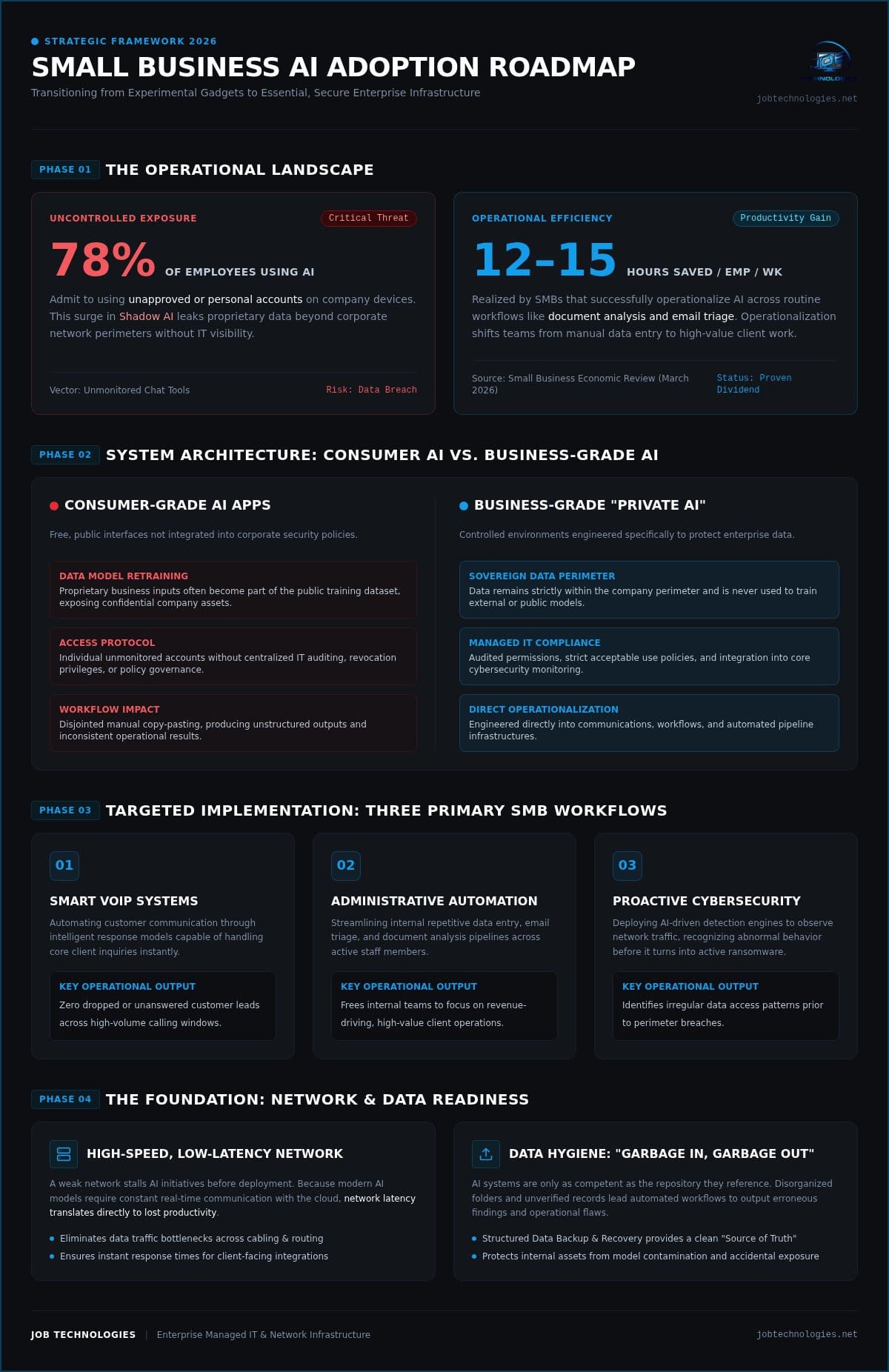
Did you know that 78% of employees who use AI at work admit to using unapproved or personal accounts on company devices? This rise in “Shadow AI” means your sensitive data might already be leaving your network through tools your IT team doesn’t even know about. It’s a stressful reality for any owner trying to build a modern AI adoption strategy for small business without risking a catastrophic data breach. You’ve likely felt the weight of information overload, wondering if these new tools are worth the security risks or the strain on your limited internal staff.
We understand that you need more than just hype; you need a stable, low-risk path forward that protects your assets while improving your bottom line. This roadmap is designed to give you exactly that. We’ll show you how to implement AI strategically to drive efficiency without breaking your budget or compromising your safety. We’ll explore how to audit your permissions, establish clear policies, and transition from basic chat tools to professional agentic workflows. By the end of this guide, you’ll have a clear plan to turn AI into a secure, proactive partner for your business’s growth in 2026.
Key Takeaways
- Shift your focus from experimental apps to essential AI integrations that streamline daily workflows and reduce operational stress.
- Prepare your infrastructure with high-speed connectivity to prevent the common performance bottlenecks that stall most AI initiatives.
- Implement a low-risk AI adoption strategy for small business by starting with high-friction tasks and conducting a thorough data security assessment.
- Safeguard your company against advanced AI-driven threats by establishing clear acceptable use policies and robust ransomware protections.
- Leverage local managed IT expertise to navigate technical complexities and ensure your technology remains a stable foundation for growth.
The 2026 AI Landscape: Why Small Businesses Can No Longer Wait
In 2026, AI adoption for SMBs is no longer about testing experimental gadgets; it’s about the practical integration of smart automation and data analysis into your daily workflows. We’ve seen a fundamental shift from “experimental AI” to “essential AI.” If your business isn’t using these tools, you’re likely working harder than your competitors to achieve the same results. This shift is a key part of your broader digital transformation, helping you stay relevant in a fast-moving market.
The efficiency gap is becoming impossible to ignore. Small businesses that successfully operationalize AI across focused workflows report saving 12 to 15 hours per employee per week on routine tasks like document analysis and email triage (Source: Small Business Economic Review, March 2026). Ignoring this technology creates a disadvantage that compounds over time. However, we see AI as a tool to be managed with a steady hand, not something to be feared. A sound AI adoption strategy for small business focuses on stability and protection rather than just chasing the latest trend.
Common AI Use Cases for Local SMBs
You don’t need a massive IT department to see immediate benefits. Many local businesses are already using these practical applications:
- Smart VoIP Systems: Automating customer communication with AI-driven responses that handle basic inquiries, ensuring no lead goes unanswered. Local businesses looking to modernize their communications can find detailed guidance in this business VoIP phone systems Dubuque buying guide to ensure call quality and network performance work hand in hand.
- Administrative Efficiency: Streamlining internal data entry and administrative tasks, which frees up your team for high-value client work.
- Proactive Security: Enhancing cybersecurity through AI-powered threat detection that identifies unusual patterns before they become breaches.
The Difference Between Consumer AI and Business-Grade AI
While it’s tempting to use free, public AI tools, doing so can put your proprietary business data at risk. When you use consumer-grade apps, your sensitive information often becomes part of the public training model. This is why we emphasize the importance of “Private AI” environments. These systems ensure that your company’s data remains yours, protected by the same rigorous standards we apply to your Managed IT Services. Business-Grade AI is a secure, controlled environment specifically designed to protect company data while leveraging the power of automation.
Developing a tailored AI adoption strategy for small business means choosing tools that respect your privacy and align with your operational goals. For Dubuque and Galena business owners looking for a structured approach, our guide to AI implementation for local businesses outlines how to build a secure, compliant framework that fits your team’s actual workflows. We’re here to help you navigate these choices, ensuring your transition into AI is smooth, secure, and profitable.
The Foundation: Preparing Your Network for AI Adoption
A weak network is the primary reason most AI initiatives stall before they even begin. If your connectivity is slow or unreliable, even the most advanced tools will feel sluggish and frustrating. High-speed, low-latency connectivity is essential because modern AI models rely on constant communication with the cloud. Latency is the enemy. Every delay in your network translates to a delay in your team’s productivity. Professional network installation ensures your business can handle the massive increase in data traffic that comes with real-time AI processing. Without a stable connection, your team will spend more time waiting for responses than actually using them.
For local owners, this starts with physical infrastructure. You can find detailed technical requirements in this professional office network wiring in Dubuque guide. Using high-quality cabling and modern hardware prevents the bottlenecks that often plague older setups. As noted in the SBA guide to AI for small business, having a reliable technical foundation is the first step toward a successful long-term AI adoption strategy for small business. We focus on building systems that don’t just work today, but stay resilient as your data needs expand.
Data Hygiene: The “Garbage In, Garbage Out” Rule
You’ve likely heard the phrase “garbage in, garbage out.” AI is only as powerful as the data it can access. If your files are disorganized or your records are inaccurate, the AI will produce flawed results. This is why a structured business data backup and recovery system is so critical. Secure data storage is the fuel for any AI strategy. It ensures your automation tools pull from a clean, protected source of truth. By organizing your data now, you reduce the risk of AI-generated errors and operational stress later.
Infrastructure Scalability
Your technology should grow with you. A successful AI adoption strategy for small business includes planning for future needs without requiring a total hardware overhaul every year. Managed IT services play a vital role here by auditing your current equipment to ensure it meets modern processing requirements. We help you choose scalable solutions that balance your current budget with your future goals. For businesses planning ahead, understanding the full scope of scaling business IT infrastructure can help you build a flexible, AI-ready foundation that supports expansion without adding layers of operational complexity. This proactive approach gives you peace of mind that your foundation is solid and ready for whatever comes next. It’s about building a partnership that supports your growth through every technical complexity.
A 5-Step AI Adoption Strategy for Small Teams
Building a successful AI adoption strategy for small business doesn’t have to be overwhelming. We’ve found that a methodical, step-by-step approach reduces stress and ensures long-term stability. Instead of trying to automate everything at once, focus on a clear, low-risk path that prioritizes your data safety and your team’s sanity.
- Step 1: Identify High-Friction Tasks. Look for low-complexity chores that eat up your team’s time, such as manual data entry, repetitive scheduling, or basic email triage.
- Step 2: Risk Assessment. Before deploying any tool, conduct a cybersecurity audit. We use the NIST AI Risk Management Framework to ensure your proprietary data stays private and secure throughout the implementation.
- Step 3: Select Closed-Loop Tools. Choose professional, business-grade platforms. These tools are designed to keep your internal data isolated, ensuring it isn’t used to train public AI models.
- Step 4: Pilot in One Department. Start small. Test the technology in customer service or billing first. This is vital because roughly 95% of AI pilots fail to produce measurable profit and loss impact when they aren’t integrated into specific workflows (Source: MIT NANDA, 2026).
- Step 5: MSP Partnership. Work with a local partner for ongoing management. This ensures your systems are monitored, patched, and updated as the technology and threat landscape evolve.
Prioritizing Your AI Investments
Avoid the trap of “Shiny Tool Syndrome.” It’s easy to get distracted by flashy apps that don’t solve real problems. Instead, calculate your return on investment by looking at actual time saved. If a tool saves your billing coordinator four hours a week, it’s a valuable asset. If it’s just a novelty, it’s a budget-breaker. A smart AI adoption strategy for small business focuses on solving core bottlenecks that hinder your growth and increase operational stress.
The Role of Employee Training
Your team is your greatest asset, and they might feel some anxiety about new technology. We’ve found that positioning AI as a “digital assistant” helps reduce this stress. It’s not here to replace them; it’s here to handle the repetitive tasks they likely dislike anyway. Establish clear policies for acceptable use so everyone knows the boundaries. This transparency builds trust and ensures your team uses AI securely and effectively every day. When your staff feels supported and trained, they’re much more likely to embrace these tools as a way to focus on high-value work.
The Cybersecurity Implications of AI in 2026
The most common question we hear from business owners is, “Is my data actually safe with AI?” It’s a valid concern. In 2026, the risk isn’t just about the AI tool itself, but how bad actors use the same technology against you. Hackers now use generative AI to craft highly convincing phishing emails that lack the typical spelling errors of the past. They also use automation to accelerate ransomware attacks, making traditional security filters less effective. A comprehensive AI adoption strategy for small business must include a plan to counter these automated threats.
Protecting your network requires more than just a standard firewall. You need AI-enhanced endpoint protection on every business computer. These tools don’t just look for known viruses; they analyze behavior in real-time to stop suspicious activity before it spreads. For a solid foundation in digital safety, we recommend reviewing our 2026 Small Business Cybersecurity Guide for Galena. It provides the essential groundwork you need before layering on advanced automation tools.
Compliance and Data Privacy
As of August 2026, new milestones in international and state regulations have brought transparency requirements into full enforcement. Small businesses are often classified as “deployers” of AI, which means you bear legal responsibility for how these tools handle customer data and privacy. Our managed IT services ensure your AI usage stays within these evolving compliance standards. We act as your proactive guardian, auditing your tools to prevent accidental data leakage or regulatory penalties that could disrupt your continuity.
Proactive Threat Hunting with AI
The best way to fight AI-driven attacks is with AI-driven defense. Modern security tools use machine learning to perform proactive threat hunting, scanning your network for tiny anomalies that a human might miss. This 24/7 monitoring is crucial because automated threats don’t take nights or weekends off. By using AI to monitor your systems, we can identify and isolate a threat in seconds. This level of protection reduces operational stress and gives you peace of mind that your assets are secure. If you want to ensure your team is fully protected against modern risks, our Cybersecurity & Ransomware Protection services provide the steady hand you need to manage these technical complexities with confidence.
Implementing AI with a Local Managed IT Partner
Choosing the right partner for your AI journey is just as important as the technology itself. While “big box” corporations or remote-only providers offer generic solutions, they often lack the local context that Tri-State businesses require. Implementing a successful AI adoption strategy for small business requires a steady hand and a deep understanding of your specific office environment. We position ourselves as your proactive guardian, ensuring that your transition to automation is seamless, secure, and grounded in your actual business goals. By being physically present in the community, we can provide the level of support that a distant call center simply can’t match.
The primary benefit of working with JOB Technologies is having a single point of contact for your entire tech stack. We manage your network installation, handle your cybersecurity, and oversee your AI implementation under one roof. This integrated approach eliminates the confusion that arises when different vendors blame each other for technical glitches. It creates a stable foundation where your technology works in harmony. You can see how our Managed IT Services in Dubuque provide the necessary growth platform to support these advanced tools without increasing your operational stress.
Customized AI Roadmaps for Tri-State Businesses
A one-size-fits-all AI strategy usually fails because it ignores the unique nuances of your industry and location. A retail business in Galena has different security priorities than a professional services firm in Dubuque. We don’t believe in generic templates. Instead, we tailor every roadmap to fit your specific workflows and budget. This local expertise allows us to anticipate challenges that remote providers might miss, such as specific regional compliance needs or local network infrastructure limitations. We’re invested in the health of our local business ecosystem because your success is our success.
Next Steps: Your AI Readiness Assessment
If you’re feeling overwhelmed by the hype, the best way to move forward is with a clear evaluation of where you stand. We invite you to a low-pressure AI Readiness Assessment. This isn’t a high-pressure sales pitch. It’s a calm, professional conversation about your current tech stack and your goals for the coming year. We’ll look at your network capacity, data hygiene, and security protocols to identify the safest starting point for your team. Our goal is to provide you with a logical path forward that offers peace of mind and tangible business value. Let’s work together to ensure your technology remains a supportive partner in your long-term growth.
Secure Your Future with a Managed AI Roadmap
The shift toward essential AI in 2026 is a significant opportunity to reclaim your time and strengthen your operations. By prioritizing a stable network foundation and following a methodical implementation plan, you can enjoy the benefits of automation without the fear of data breaches or budget overruns. A successful AI adoption strategy for small business isn’t about chasing every new app; it’s about building a secure environment where your team can thrive.
We’ve spent over 20 years supporting Dubuque small businesses through every technical change. Our approach includes proactive ransomware protection and local, on-site support for firms across Galena and the Tri-State area. You don’t have to handle these technical complexities alone. We’re here to act as your proactive guardian, ensuring your technology remains a steady asset for your growth. Schedule your AI Readiness Assessment with JOB Technologies today to see how we can help you build a reliable path forward. Your business deserves the peace of mind that comes with a professional partnership.
Frequently Asked Questions
Is AI too expensive for a small business with under 20 employees?
No, AI is not too expensive because many business-grade tools operate on a per-user subscription model that scales with your team size. This allows Dubuque firms to pay only for the seats they actually need while accessing the same powerful technology as larger corporations. We focus on a lean AI adoption strategy for small business that identifies high-ROI tasks first. This approach ensures you aren’t overspending on technology that doesn’t provide immediate value to your daily operations.
Can AI help protect my business from ransomware attacks?
Yes, AI is a powerful ally in the fight against ransomware because it can detect behavioral anomalies that traditional antivirus software might miss. Modern security tools use machine learning to scan your network for suspicious activity 24/7. This proactive approach allows us to isolate threats before they can encrypt your data. For businesses in Galena, this means reduced operational stress and a much higher level of protection against the increasingly sophisticated attacks we see today.
Do I need to upgrade my office network before using AI tools?
You should evaluate your network before implementation because AI tools rely on high-speed, low-latency connectivity to function correctly. If your office in East Dubuque is still running on older Wi-Fi standards or outdated wiring, you’ll likely experience frustrating bottlenecks. We recommend a professional network audit to ensure your infrastructure can handle the increased data traffic. A stable foundation is necessary to prevent your new automation tools from slowing down your entire team’s productivity.
How does AI adoption impact my business compliance and data privacy?
AI adoption significantly impacts your compliance requirements because you’re often legally responsible for how these tools handle sensitive customer information. Under current regulations, you must ensure that your AI providers don’t use your proprietary data to train their public models. We provide compliance assistance to help Dyersville business owners navigate these rules. Our goal is to ensure your AI adoption strategy for small business remains secure and fully aligned with modern data privacy standards.
What is the first AI tool a small business should implement?
The best first step is usually implementing a secure, business-grade assistant within your existing productivity suite, such as Microsoft 365 or Google Workspace. These tools offer a familiar environment for your staff while providing immediate help with email triage, document analysis, and scheduling. Starting with these sanctioned platforms is safer than letting employees use free, personal accounts. It gives your Dubuque team a low-risk way to experience efficiency gains while keeping your company data protected.
What happens if we use AI and our internet goes down?
If your internet goes down, most cloud-based AI tools will become temporarily unavailable, much like your email or VoIP phone systems. This is why we emphasize business continuity and robust data backup solutions for our local partners. While the AI functions might pause, your local files and core network should remain secure. We help you design a resilient infrastructure that includes redundant connections to ensure your Galena business stays operational even when the primary link fails.
How can a managed IT provider help with AI strategy?
A managed IT provider acts as your proactive guardian by handling the technical complexity of AI implementation so you can focus on growth. We help you select the right tools, audit your network permissions, and provide 24/7 security monitoring. Instead of guessing which technology is safe, you get a clear, structured roadmap tailored to the Tri-State area. We ensure your AI tools integrate seamlessly with your existing systems without creating new vulnerabilities for your business.
Will AI replace my current small business staff?
No, AI is designed to support your staff by handling repetitive chores, not to replace the human expertise that makes your business successful. We position AI as a digital assistant that takes over high-friction tasks like data entry or initial customer routing. This allows your Dubuque team to focus on high-value work that requires empathy and complex problem-solving. When implemented correctly, these tools reduce employee burnout and help your small team achieve much more without adding extra stress.