

A provider’s “HIPAA-ready” label isn’t proof that your practice is protected. HIPAA compliant IT support Dubuque healthcare organizations can evaluate should make responsibilities clear, explain which safeguards it manages, and provide evidence of the work. That clarity matters when a cyber incident or system outage could disrupt care or put sensitive information at risk.
An IT partner can help reduce technical risks, but technical support doesn’t transfer every responsibility or guarantee HIPAA compliance. This guide explains what healthcare practices should look for, what to ask a local provider, and how to assess broad compliance claims. You’ll find practical ways to review security practices, backup and recovery plans, support expectations, documentation, and service scope. These details can help practices in Dubuque and nearby communities compare options and choose a partner with a clear approach to protecting systems and supporting continuity of care.
Key Takeaways
- Understand how your practice’s responsibilities and its IT vendors’ roles affect the protection of electronic health information.
- Connect HIPAA safeguards to everyday IT practices, including access management and system monitoring.
- Evaluate HIPAA compliant IT support Dubuque providers by asking for specific evidence about agreements, security documentation, backups, and incident response.
- Use a practical readiness plan to map systems and vendors, review risks, and prioritize improvements.
- Compare local partners based on accountability, technical services, documentation, and communication, not broad compliance claims.
What HIPAA-Focused IT Support Means for Dubuque Healthcare Practices
HIPAA-focused IT support helps protect the systems that store, process, or transmit electronic protected health information (ePHI). For a Dubuque practice, that may include managing network security, controlling system access, monitoring for suspicious activity, and planning how to restore systems after an outage. If you want to explore how robust infrastructure maintains clinical uptime, check out MEDITIL for guidance on managing high-volume healthcare networks. The exact work depends on the provider’s services and the agreement in place.
The Health Insurance Portability and Accountability Act (HIPAA) includes privacy and security requirements, but hiring an IT provider doesn’t make an organization compliant by itself. When reviewing HIPAA compliant IT support Dubuque providers, look for specific descriptions of technical responsibilities and the records they can provide. Be cautious of blanket promises that a provider will make your practice HIPAA compliant.
For a broader introduction, watch this overview of HIPAA compliance:
Which Dubuque-area organizations may need HIPAA-aware IT support?
Healthcare providers, health plans, and healthcare clearinghouses may be covered entities, depending on their activities and circumstances. A vendor may have business associate responsibilities if it performs work for a covered entity that involves creating, receiving, maintaining, or transmitting ePHI. An IT provider’s status depends on its services and access to data, not simply its job title. Confirm your organization’s status and contractual duties with qualified compliance or legal counsel.
What should a healthcare IT provider be responsible for?
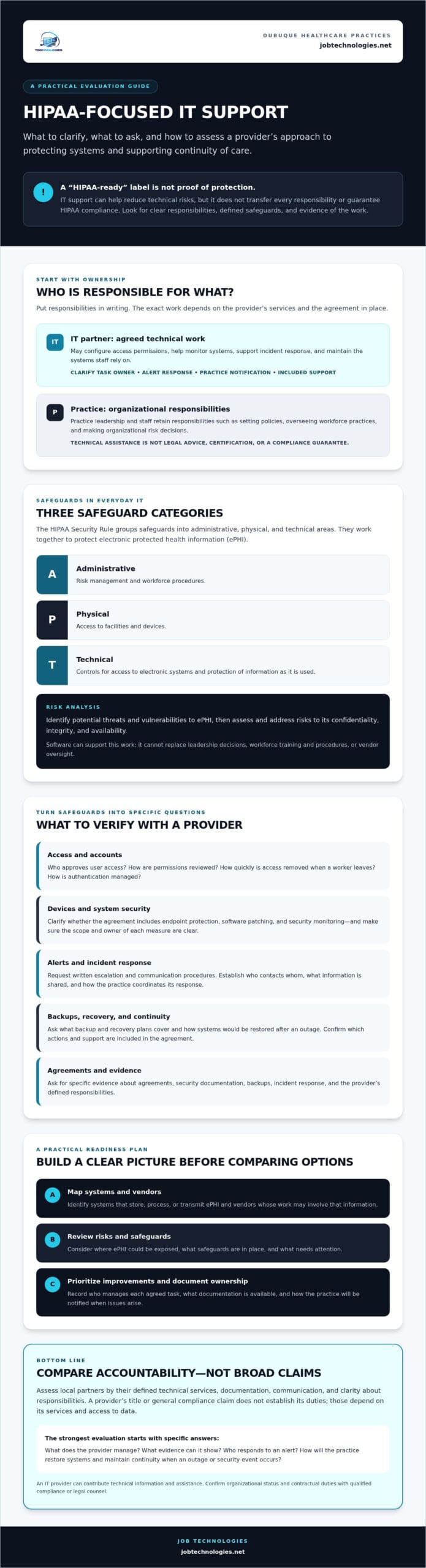
An IT partner may manage agreed technical safeguards, such as configuring access permissions, helping monitor systems, supporting incident response, and maintaining the systems staff rely on. Define these tasks in writing. Clarify who acts when an alert occurs, how the practice is notified, and which support is included.
Practice leadership and staff still have responsibilities, including setting policies, overseeing workforce practices, and making organizational decisions about risk. An IT provider can contribute technical information and assistance, but shouldn’t be treated as responsible for every HIPAA obligation. Clear boundaries help both sides understand who owns each task.
At a glance: HIPAA compliance support is technical assistance that can help an organization apply and document safeguards. It isn’t legal advice, a certification, or a guarantee that the organization meets every requirement.
How HIPAA Security Safeguards Translate Into Everyday IT Practices
The HIPAA Security Rule organizes safeguards into three categories: administrative, physical, and technical. HHS’s HIPAA Security Rule summary explains how they work together to protect electronic protected health information. Administrative safeguards include risk management and workforce procedures. Physical safeguards address access to facilities and devices. Technical safeguards help control access to electronic systems and protect information as it’s used.
A risk analysis helps an organization identify where ePHI could be exposed and decide what needs attention. Put simply: A risk analysis identifies potential threats and vulnerabilities to ePHI so an organization can assess and address risks to its confidentiality, integrity, and availability. Software can support that work, but it can’t replace leadership decisions, workforce training and procedures, or oversight of vendors that handle data.
How should access, devices, and security events be managed?
Ask how the provider manages user accounts and permissions. Who approves access? How are permissions reviewed? How quickly is access removed when a worker leaves? Clarify how authentication is managed and whether the agreement includes endpoint protection, software patching, and security monitoring. Each measure is useful only when its scope and owner are clear.
Find out what happens when monitoring identifies a potential security event. Request written escalation and communication procedures that explain who contacts whom, what information is shared, and how the practice coordinates its response. An IT provider may help investigate and address technical issues, while the organization remains responsible for broader decisions and obligations.
What role do backups and recovery play in healthcare IT?
A backup is useful only if the practice can restore the information and systems it needs. Ask what data is backed up, how often backups run, how long they’re retained, and whether restoration is tested. Confirm who handles recovery tasks and how the provider will coordinate with practice staff if essential systems become unavailable.
Relate those answers to clinical operations: which systems are most critical, and what recovery priorities support continuity of care? For more questions to take into a planning discussion, see this business data backup and recovery guide. Practices comparing HIPAA compliant IT support Dubuque providers can also review managed IT and data recovery capabilities as part of their evaluation. Healthcare practices should also understand how ransomware specifically targets backup repositories — reviewing a guide to ransomware recovery services for business can help clarify what to ask about backup integrity and restoration procedures.
How to Compare HIPAA-Compliant IT Support Providers in Dubuque
A provider’s claim that it is “HIPAA compliant” doesn’t explain what it will do for your practice. No vendor can make an organization compliant simply by supplying IT services. Use the agreement, assigned responsibilities, and documented evidence to assess whether the provider’s work supports your security program. HHS offers official HIPAA security guidance that can help inform your review.
Compare providers using the same practical criteria:
| Area | What to clarify and request |
|---|---|
| Scope | Which systems, devices, and services are included? What’s excluded? |
| Agreement | Will the provider sign a business associate agreement when applicable, and which services and data does it cover? |
| Security documentation | What records can demonstrate security work, access reviews, and remediation? |
| Backups | What data is backed up, how are restoration tests documented, and who handles recovery? |
| Incident response | Who escalates a suspected incident, communicates with the practice, and documents actions? |
| Support availability | What support hours, contact methods, escalation steps, and response targets are written into the agreement? |
Which questions should you ask before signing an IT agreement?
Ask the provider to describe its role if a security event affects systems or data. Who investigates technical issues? Who informs practice leadership? How will both teams coordinate? Request a written list of included services, exclusions, escalation steps, and how often responsibilities are reviewed. If a business associate agreement applies, confirm whether the provider offers one and make sure it covers the services and data access involved.
What evidence helps verify a provider’s claims?
Ask for relevant service descriptions, security documentation, policies, and references where available. Look for records that show work was completed, such as documented access reviews, backup restoration tests, incident actions, and remediation tracking. A polished presentation or general promise isn’t a substitute for evidence you can examine. This managed IT services guide for Dubuque offers additional context for evaluating service scope.
Consider local fit as well. If your practice is in Dubuque, Galena, East Dubuque, Dyersville, Farley, or Peosta, ask whether support is remote, onsite, or both, which locations are covered, and what availability and response expectations are written into the agreement. Don’t assume proximity guarantees a particular response time or onsite visit. To review a potential local partner’s stated services, visit JOB Technologies’ managed IT and cybersecurity services.
A Practical HIPAA IT Readiness Plan for a Dubuque Healthcare Practice
A clear inventory gives your practice and a potential IT provider a shared starting point. It can also reveal overlooked systems, vendor access, and recovery needs. Use this sequence to prepare for a review, not as a stand-alone HIPAA compliance checklist.
- Map systems and vendors. List clinical and billing systems—such as EHR platforms or specialized radiology management software—email, computers and mobile devices, network equipment, cloud services, and vendors that may access or maintain electronic protected health information (ePHI). Note how information moves between systems and who can access it.
- Document current responsibilities. Record support arrangements, known technical issues, account and access owners, backup arrangements, and the systems staff need to keep care operations moving. Identify which vendor is responsible for each service and where ownership is unclear.
- Review risks and workflows. Consider how staff use systems day to day, where sensitive data is stored or shared, and what could interrupt access. Include workforce procedures and vendor oversight, not just technical settings. A qualified compliance or legal adviser can help interpret your organization’s obligations.
- Prioritize remediation and continuity. Group issues by operational importance, assign an owner, and document the next step. Identify essential systems, recovery needs, internal escalation contacts, and how staff should communicate if normal workflows are disrupted.
- Plan any support transition. Ask for a phased onboarding plan that accounts for clinical schedules and critical systems. Confirm how account access and existing documentation will transfer, how backups will be validated, and who will communicate changes to staff.
What should you gather before a provider assessment?
Prepare a practical snapshot, not a perfect technical map. Include system and vendor names, what each is used for, whether it handles ePHI, who can access it, and who supports it now. Add known issues and recovery priorities. These details help a provider ask focused questions about data flows and responsibilities instead of relying on assumptions.
How can you plan a safe transition to new IT support?
Agree on the order of work before changes begin. Coordinate account transfers, documentation access, backup checks, and staff communications with the people responsible at your practice and with your other vendors. A small business cybersecurity guide for Galena can provide additional planning context.
During an incident, documented ownership helps everyone know who must act, who must communicate, and what information needs to be preserved. That clarity supports coordination, but it doesn’t replace the organization’s own policies or compliance decisions. Practices that haven’t yet documented recovery priorities, assigned responsibilities, and communication steps can use a disaster recovery planning template for businesses to structure that work before an incident occurs. For help discussing managed IT, cybersecurity, backup, recovery, or compliance assistance, talk with JOB Technologies about your practice’s IT needs.
Choosing a Local HIPAA-Focused IT Partner in Dubuque
The right IT partner should make responsibilities easy to understand. Look for a clearly defined service scope, relevant technical capabilities, useful documentation, and a communication process your practice can follow. A provider can help manage technology safeguards, but it doesn’t replace your compliance lead, legal counsel, or practice leadership, and it can’t guarantee your organization’s overall HIPAA compliance.
JOB Technologies provides managed IT, cybersecurity and ransomware protection, data backup and recovery, and compliance assistance. These services may be relevant to a practice looking for help with day-to-day technology and continuity planning. Before moving forward, confirm directly with JOB Technologies whether it signs a business associate agreement when applicable, which services the agreement would cover, and how the proposed work relates to systems or data in your practice.
When could a local managed IT partner be a practical fit?
A managed IT partner may be useful if you want coordinated support for computers, networks, email, security, and recovery rather than managing separate technical needs without clear ownership. Ask how the provider works with your existing applications and vendors, and what documentation it can share about work performed. Confirm local support arrangements for your community and agreement, including whether support is remote or onsite and any applicable availability terms.
Local proximity can make communication feel more direct, but it isn’t proof of healthcare expertise or a particular response time. Verify capabilities and expectations in writing. Your practice remains responsible for organizational decisions and should continue to involve the people responsible for compliance and legal guidance.
What should happen in an initial conversation?
Bring a concise picture of your systems, clinical and operational priorities, known risks, and current support gaps. Explain which technology is essential to daily workflows and where you need clearer ownership. Then ask what an assessment would cover, what information the provider needs, what the next steps would be, and how service responsibilities will be documented.
Choose a partner based on answers you can verify, not a broad “HIPAA compliant” claim. A productive discussion should leave you with a clearer view of scope, open questions, and practical next steps, without confusing IT assistance with a compliance guarantee.
If your practice is evaluating HIPAA compliant IT support Dubuque, talk with JOB Technologies about your IT support needs and the services that may fit your organization.
Build a Clearer Path to Healthcare IT Readiness
Strong healthcare IT support starts with clear boundaries. Know which systems and vendors handle electronic protected health information, document who owns each safeguard, and ask providers for evidence of their work. Managed IT can support security, backup, recovery, and continuity, but your practice remains responsible for its broader compliance program.
As you compare HIPAA compliant IT support Dubuque options, focus on written service scope, incident communication, recovery planning, and support expectations. JOB Technologies offers managed IT, cybersecurity, backup and recovery, and compliance assistance. Practices in Dubuque, Galena, East Dubuque, Dyersville, Farley, and Peosta can ask about the services and support arrangements available for their specific needs.
Ready to discuss your systems, priorities, or support gaps? Talk with JOB Technologies about your healthcare IT support needs, and ask what services and responsibilities would be included. A careful conversation is a practical first step toward a better-documented, more resilient IT environment.
Frequently Asked Questions
Is a HIPAA-compliant IT support company enough to make a healthcare practice compliant?
No. An IT provider can support technical safeguards, but it can’t guarantee the practice’s overall HIPAA compliance. Responsibilities depend on whether the organization is a covered entity or business associate and on the provider’s agreed scope. Review your risk-management responsibilities with qualified compliance or legal advisers, and confirm how each vendor handles protected health information and documents its work.
Can an IT provider sign a business associate agreement?
Yes. An IT provider may need to sign a business associate agreement if its services involve handling protected health information on behalf of a covered entity or another business associate. The answer depends on the relationship, services, and data access. Ask whether the provider signs an agreement, which specific services it covers, and how responsibilities are divided before work begins.
What should HIPAA-focused IT support include?
There’s no single scope for every provider, so ask what the proposed service actually covers. Topics to clarify include account access, security monitoring, software patching, backup and recovery, incident escalation, and documentation. Confirm who performs each task, what’s excluded, and how often reviews take place. Technical support can help protect systems, but it doesn’t replace practice policies, workforce procedures, or qualified compliance advice.
How do I choose HIPAA-compliant IT support in Dubuque?
Compare written service scope, agreement terms, security documentation, backup and restoration processes, incident communication, and support availability. When evaluating HIPAA compliant IT support Dubuque practices can use, ask providers to substantiate their claims and clarify whether support covers your location. If your organization is in Dubuque, Galena, East Dubuque, Dyersville, Farley, or Peosta, confirm local arrangements directly. Consult qualified advisers about your obligations.
How much does HIPAA-compliant IT support cost?
Costs vary with the organization’s size, systems, security needs, and the services included in the agreement. Request a written scope that explains what’s included, what may be billed separately, and how onboarding or project work is handled. Compare proposals based on responsibilities and deliverables, not just a headline figure. For compliance-related questions, consult a qualified adviser rather than relying on a vendor’s sales description.
What happens if a healthcare practice has a data breach?
Follow the practice’s incident-response procedures, preserve relevant information, and promptly involve the people responsible for security, privacy, legal, and regulatory decisions. An IT provider may help investigate or contain a technical issue if those tasks are within its agreed scope. The facts and current requirements determine any response or notification duties, so confirm next steps with qualified counsel and official guidance.
Can a managed IT provider help with HIPAA risk analysis?
A managed IT provider may contribute technical information or assist with parts of a risk analysis if the work is within its capabilities and agreed scope. The organization remains responsible for ensuring its risk-management process reflects its systems, operations, and obligations. Ask what deliverables the provider supplies, who owns the assessment, and whether a qualified compliance professional should participate in reviewing the results.